MELTING OF THE PERMAFROST & RISING SEALEVELS

As may be evident by now, the lines
between effects of global warming to the ocean are blurred. There are no
distinct cut-offs. Warmer oceans and rising sea levels are not distinct, but
compound each other. The same goes for the melting of the permafrost and rising
sea levels. Relationships between permafrost melt and warmer oceans can be
found also. The point is that the issues surrounding our present day oceans are
nut cut and dry, they are fluid (no pun intended). This page, therefore, may
have some redundancies when it comes to sea-level rise, but I believe it is
important to tackle this phenomenon from different angles. My goal in this section
is to review the current literature surrounding specifically melting of the
permafrost: glaciers, mountain snowpack, and other forms of ice that have been
frozen for thousands of years. I will also discuss the consequences of the
melting of ice pack, with regards to biological systems and humans.

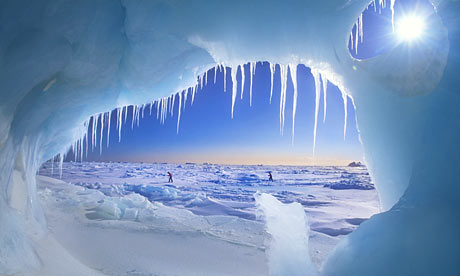
Warmer planet = less permafrost.
Research
The current
literature on global warming indicates that the Arctic regions of our planet
warmed at nearly twice the rate of equatorial latitudes (Ardt et al. 2011). The Cryosphere, areas containing large masses
of snow and ice not necessarily in the Arctic regions, is also expected to
continue to lose mass in the coming decades (Scambos, 2011). Records of ice
mass in Greenland show that it has lost more mass in the past decade than in
any other recorded period in history, with the melt rate recorded at its
highest since 1958. Due to abnormally
high summer temperatures, coupled with a melt season that is historically
longer than typical, the Canadian Arctic experienced an increase in the rate of
ice loss from glaciers and ice caps. Glaciers have always
fluctuated throughout history in size, but the current rate of loss has not
been seen before. Our planet has seen loss of mass in alpine glaciers for 20
years straight, and permafrost (water typically locked up for long periods of
time) temperatures have risen by 2oC in the past three decades
(Arndt et al. 2011). So what is causing all of this?
We have heard the
data before, but here it is again: atmospheric CO2 concentrations have
increased dramatically since the industrial age, and have remained between 2
and 4 times as high as levels previously seen. Huybrechts and colleagues
estimate that at our current CO2 levels the Greenland ice sheet will
be completely lost within the next 3,000 years- a blink of an eye in geological
time (Huybrechts et al. 2011). HIS/HER team investigated scenarios based on current
CO2 levels, and found that this and other ice loss in the Antarctic
could contribute to more than 4 meters of sea level rise in that time period!
Losses in permafrost mass shouldn’t be instantaneous in all cases, however.
Some models indicate that the Antarctic ice sheets will actually grow in the
next 1200 years or so. This increase in size is due to increased predictions
for rain as the planet continues to warm. This rain will accumulate in the
Arctic region, which will remain cold enough for ice formation. This accumulation trend is expected to revert
to loss trends after the initial 1200 years. This is still
under debate though, as some studies have shown a net loss of 100-200 gigatons
of ice per year from each ice sheet each
year into the ocean. It takes 360 gigatons of ice to raise the sea by 1 millimeter,
according to one estimate (Scambos, 2011). It is unanimously accepted that lower
latitudinal ice sheets can expect to see losses much sooner, however.
Summer ice has been
at record and near-record low levels in recent years. The Himalayan and Tibetan Plateau Glaciers
have been experiencing a widespread loss of their glaciers and snow cover
(Prasad et al. 2009). This is soley due to the fact that the globe has warmed the
cryosphere to the point or near the point of freezing, postulates Scambos and
colleagues. Scambos further states that the processes leading to the loss of
ice are easily set in motion, but are not easily reversed. Melting permafrost
may therefore create a sort of cascade effect that may be irreversible. Recent
changes in wind pattern due to global warming have also been proposed as exacerbating
the ice melt problem by pushing ice into warmer water (Scambos, 2011). This
idea will be touched upon more extensively in the next tab (Changes to Major
Ocean Currents).

One example of a retreating glacier in Canada
Consequences
So why should we
care about permafrost melt? The reasons are many. Biological systems in the
Arctic oceans would be majorly disrupted by an environment with no or little
ice. This includes both terrestrial and marine ecosystems. These marine
ecosystems will most likely see a change in primary production (phytoplankton
mass) and general water flow patterns, which could affect entire food webs, all
the way up to our charismatic Polar Bears (Huybrechts et al. 2011). One study even
shows that chemical cycling, especially the carbon cycle related to
carbohydrates in primary producers and consumers, could be dramatically altered
if ice dissipates in the Arctic. This would affect the ‘biological pump’ that
keeps many ecosystems running in the Arctic regions, thereby negatively
impacting the entire biome (Sala et al. 2010). Humans may further stress the Arctic
environment as ice melts, because more ocean would open to previously
unavailable fisheries. It is clear that ice melt will have
far reaching implications in the biological realm.


Decrease in ice pack will have far reaching consequences for biota in Arctic regions.
Beyond biological
diversity issues, many concerning consequences will be directly experienced by
humans. Vast areas in Asia will have
dramatically altered water tables if ice melt continues. Major rivers, such as
the Indus, Ganga and Brahmaputra, are fed by glacial meltoff. A complete
melting of ice sheets will therefore negatively impact agriculture and water
resources in an already stressed region of the world (Prasad et al. 2009). Areas that are considered lowlands will also
see increases in flooding and debris flow due to melting glaciers, a
consequence of rising sea levels and deteriorating alpine cold meadows. Land in
these areas will also experience erosion at greater rates than previously seen,
due to freeze and thaw patterns atypical to the region. These increased
flooding and debris patterns, along with heightened erosion, will affect some
of the most densely populated areas of the world, specifically China and India
(Zhang et al. 2011).

Some tropical areas of the world may be completely covered if the oceans continue to rise.

No comments:
Post a Comment